

Delivering premium video securely at scale means choosing the right adaptive streaming protocols while protecting content with multi-DRM. HLS and MPEG-DASH remain the two dominant standards. Both rely on adaptive bitrate streaming. CMAF (Common Media Application Format) has become the practical unifier that lets operators package once and serve both.
HLS: HTTP Live Streaming
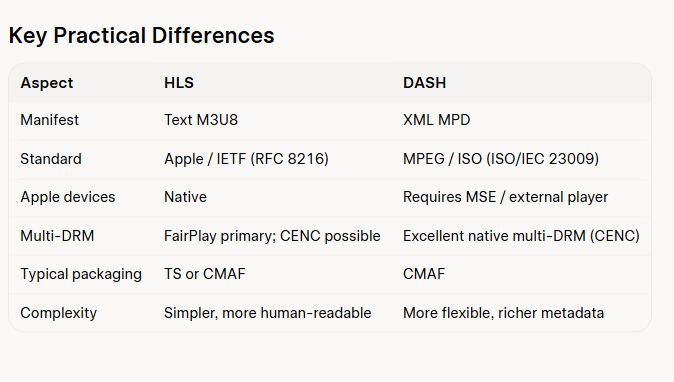
Developed by Apple in 2009 and standardized as RFC 8216, HLS is the most widely supported adaptive bitrate protocol. It uses text-based M3U8 playlists: a multivariant (master) playlist that lists available quality levels and codecs, plus media playlists that list the individual segments.
HLS has native support across every Apple device (iOS, iPadOS, macOS, tvOS) and Safari. It also works on the majority of other platforms through players. For DRM, HLS is the required path for Apple FairPlay Streaming. It can also carry Widevine and PlayReady when segments are packaged as CMAF using Common Encryption (CENC).
MPEG-DASH: Dynamic Adaptive Streaming over HTTP
MPEG-DASH is the open international standard (ISO/IEC 23009-1). Its manifest is an XML Media Presentation Description (MPD) that organizes content into periods, adaptation sets (for example, all video renditions or a specific audio language), and representations (specific bitrate/codec versions). Segments are container- and codec-agnostic; in practice they are almost always CMAF fragmented MP4.
DASH has excellent native multi-DRM support. A single MPD can signal Widevine and PlayReady side-by-side via CENC. It is natively supported on Android (ExoPlayer), most smart TVs, and browsers via Media Source Extensions plus libraries such as dash.js or Shaka Player. It is not natively supported on Safari or on iOS.
The Rise of CMAF
CMAF (ISO/IEC 23000-19) is the fragmented MP4 container that has become the common media format for both protocols. By packaging content once as CMAF segments encrypted with CENC (typically using the CBCS scheme that FairPlay requires, while still supporting the schemes used by Widevine and PlayReady), operators generate two manifests from the same encrypted media:
- An HLS playlist that directs Apple devices to FairPlay licenses.
- A DASH MPD that signals Widevine and PlayReady.
The encrypted segments themselves are identical and can be cached once on the CDN. This “package once, deliver everywhere” model is the foundation of modern multi-DRM workflows. It eliminates redundant encoding and storage while satisfying studio requirements for FairPlay on Apple platforms and CENC-based DRM elsewhere.
BuyDRM’s KeyOS platform is built for exactly this architecture. KeyOS MultiKey delivers studio-approved licenses for FairPlay, Widevine, and PlayReady. MultiPack and partner integrations handle CMAF packaging with CENC/CBCS, and MultiStream provides just-in-time packaging and origin delivery for both HLS and DASH.
Low-Latency Variants: LL-HLS and LL-DASH
Standard HLS and DASH with 4-6 second segments typically produce 15-30 seconds of glass-to-glass latency. Low-latency extensions close that gap to roughly 2-5 seconds while remaining on HTTP and CDN infrastructure.
- LL-HLS divides segments into shorter “parts” (commonly 200-500 ms CMAF chunks) listed with EXT-X-PART tags. It uses blocking playlist reloads, preload hints, and server control directives so the player stays close to the live edge.
- LL-DASH uses the same CMAF chunks delivered via HTTP chunked transfer encoding. The MPD includes availabilityTimeOffset so the player can request a segment before it is fully written and consume the chunks as they arrive.
Because both rest on CMAF chunks, a single low-latency packager can emit one set of media and two manifests (LL-HLS and LL-DASH). The choice of which manifest to serve is driven by the client: native LL-HLS for Apple devices, LL-DASH (via dash.js, Shaka, or ExoPlayer) for everything else. KeyOS is optimized for low-latency streaming and supports the DRM signaling required by both variants.
Practical Recommendations for Multi-DRM Operators
- Package to CMAF with CENC (CBCS for FairPlay compatibility) whenever possible.
- Generate both an HLS playlist (FairPlay) and a DASH MPD (Widevine + PlayReady) from the same segments.
- For live, evaluate LL-HLS and LL-DASH when sub-5-second latency is required; confirm CDN support for chunked transfer, blocking requests, and high request rates.
- Use a multi-DRM license service (such as KeyOS MultiKey) that can issue the correct licenses for each protocol from a single content key workflow, ideally via CPIX.
- Test across the full device matrix-native Apple players, Android, smart TVs, and browser players-because DRM and low-latency behavior can differ even when the media is identical.
HLS remains essential for the Apple ecosystem and FairPlay. DASH remains the more flexible open standard for multi-DRM on non-Apple platforms. CMAF plus dual manifests is the current best practice that lets operators avoid duplicating media while meeting studio requirements. Low-latency extensions of both protocols extend the same model to live experiences that compete with traditional broadcast delay.
KeyOS supports the full stack-HLS and DASH packaging, CMAF/CENC multi-DRM, low-latency workflows, and forensic watermarking-so content owners can focus on the viewing experience rather than protocol and encryption complexity.